DISCLAIMER: This content is intended to provide general information and does NOT serve as professional advice and is NOT intended to replace a professional healthcare provider’s recommendation. Your registered healthcare provider remains your most reliable source of information, and we suggest reaching out to professionals when facing any health-related issues and emergencies.
Introduction: Why Families Should Know Basic Life Support in Pregnancy
Although most pregnancies are healthy, emergencies like cardiac arrest, breathing problems, severe bleeding, seizures, or choking can happen without warning. Early recognition and immediate action can make a life-saving difference.
When a pregnant woman has a medical emergency, every second counts. Family members, partners, and bystanders are often the first to respond, and knowing the basics of basic life support in pregnancy can help you act quickly and confidently while waiting for professional care.
The best way to prepare for such emergencies is to take an officially recognized BLS course and go through the appropriate hands-on training. However, in this post, we try to review the important concepts of BLS in pregnancy and provide general information to help you make appropriate decisions under the stressful situation of an emergency.
The goal is simple: learn to recognize an emergency early on, call for help, activate emergency medical services (EMS), and start CPR if needed.
Step I. Assessment: Check Safety and Responsiveness First
The first step in a pregnancy emergency is to ensure the scene is safe.
Before approaching, quickly look for anything dangerous, such as traffic, fire, smoke, exposed wires, falling objects, or unsafe surroundings. If the area is unsafe, do not put yourself in danger. Call EMS and wait for trained responders if needed.
Once it is safe to approach, check whether the pregnant woman is responsive. Speak loudly and clearly. Tap her shoulders and ask if she is okay. Look for any movement, sounds, or responses.
If she does not respond, treat it as a medical emergency.
Step II. Early Interventions: Call for Help, Activate EMS, Get an AED
When a pregnant woman is unresponsive, act quickly. Call out for help right away. If other people are nearby, ask them to call EMS and to get an AED if one is available.
If you are alone and have a phone with you, call EMS immediately and put the phone on speaker so you can follow instructions while staying with the patient.
Try to complete the above tasks as soon as possible so you would be able to get back to assessing the victim’s condition, including pulses and breathing.
These early actions are critical in cardiac arrest in pregnancy:
- call for help
- activate EMS as soon as possible
- retrieve an AED
Step III. CPR in Pregnancy: When It Is Needed and How to Do It
At this step, the EMS should already be enabled with help on the way. Now it would be useful to know when and how to begin CPR in pregnancy while waiting for the EMS to arrive.
Next, you need to assess whether the victim is breathing normally and has a pulse. This information will guide your next steps.
These two assessments can be completed by looking at the victim’s chest rise in rhythm for breathing and checking their pulse on the carotid artery on their neck, at the same time. Since time is of the essence, try to act quickly and take no longer than 10 seconds on this step.
If you feel a pulse and the victim is breathing normally, stand by their side until the EMS arrives, and monitor them every 2 minutes. Watch out for any changes in pulses and breathing and move on to the appropriate steps when necessary.
If the pregnant woman has a pulse but is not breathing normally, provide rescue breathing if you are trained. Use available equipment like a bag-mask device if possible. For mouth-to-mouth breathing, the decision is up to the rescuer, based on personal safety, comfort, and available protection. Provide rescue breathing at the rate of once every 5 – 6 seconds.
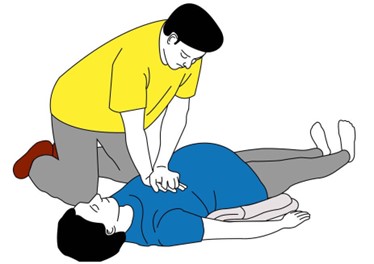
Start CPR in pregnancy if the woman is unresponsive, not breathing normally, and no definitive pulse is felt. If she is gasping or only taking occasional abnormal breaths, treat this as a sign that CPR may be needed.
Conclusion: Learn the Basics, but Take a Certified Course Knowing the basics of basic life support in pregnancy can help families and bystanders act quickly in a true emergency. The key steps reviewed in this post include:
- Check for safety
- Assess responsiveness
- Call for help
- Activate EMS, get an AED
- Assess victim’s pulse and breathing
- Start CPR if needed
Still, this article is only a general overview. It is not a replacement for an official BLS or CPR course. Taking a certified course can help people feel more prepared and more confident in a real emergency. If you are pregnant, live with someone who is pregnant, or support pregnant family members, it is worth considering formal CPR and BLS training. For all pregnancy-related health concerns, always rely on the advice of qualified healthcare professionals.
In the next posts we will discuss the next steps in BLS for pregnant victims.
Feel free to share your experience with emergencies in pregnancy and how prepared you felt when dealing with them. Do you feel more confident in facing emergencies after reading this article? How about after taking a basic life support course? We are looking forward to hearing your thoughts on this subject and what you think is the best subject to cover in our next post.