DISCLAIMER: This content is intended to provide general information and does NOT serve as professional advice and is NOT intended to replace a professional healthcare provider’s recommendation. Your registered healthcare provider remains your most reliable source of information, and we suggest reaching out to professionals when facing any health-related issues and emergencies.
Introduction
In the previous post we discussed the early steps to recognizing an emergency and activating the EMS, and early assessment of the victim’s breathing and pulses. Now we discuss how to provide high quality chest compressions and how to use an AED, as well as what to do in cases of choking.
High-quality chest compressions
Good chest compressions are the foundation of CPR. Push hard and fast in the center of the chest. Make sure the patient is lying on a safe, flat, and firm surface.
For adults, high-quality chest compressions mean:
- 100 to 120 compressions per minute – A practical way of is to push to the rhythm of “Stayin’ Alive” by the Bee Gees
- Depth of about 5 cm
- Allowing full chest recoil after each compression – Do NOT lean on the chest between each compression
- As few and small interruptions as possible (maximum 10 seconds)
If you are providing both rescue breaths and chest compressions, use cycles of 30 chest compressions and 2 breaths, 5 – 6 seconds apart. Each breath should make the chest visibly rise.
If you are not trained or not comfortable giving breaths, hands-only CPR is still much better than doing nothing.
Lateral displacement of the uterus
A key pregnancy-specific point is the displacement of the enlarged uterus to the left side. Later in pregnancy, as the enlarged uterus presses on major blood vessels when lying flat on the back, the blood flow back to the heart can be reduced, which can make resuscitation less effective.
Moving the uterus to the left can help improve circulation. This is usually most relevant in the second half of pregnancy.
For general bystanders, the important message is simple: this adjustment may help in late pregnancy, but it should never delay CPR. High-quality chest compressions remain the priority.
Step IV. Automated External Defibrillator (AED): When and How to Use It
An AED in pregnancy should be used just as it would be for any other adult in cardiac arrest. Pregnancy is not a reason to avoid using an AED.
Use the AED as soon as it is available:
- Turn it on
- Follow the voice prompts
- Place the pads on the bare chest as shown on the device
- Make sure no one is touching the patient while the AED analyzes – The AED prompts a clear message when this is necessary
- Deliver a shock if the AED says one is needed
- Resume CPR immediately after the shock, or right after the machine says no shock is advised
- Try to minimize interruptions to less than 10 seconds when using the AED
AEDs are made to be simple to use. The most important thing is to turn the device on quickly and listen carefully to its instructions.
Step V. Continue Care Until Advanced Rescuers Arrive or the Victim Regains Consciousness
Once care has started, keep going until EMS or another advanced responder takes over, or until the victim shows signs of recovery.
Teamwork can make a big difference. Chest compressions can be exhausting. If another person is available to help, take turns about every 2 minutes, while keeping pauses very short.
Special Condition: Choking in Pregnancy
Choking in pregnancy should be managed quickly and calmly.
If the pregnant woman is coughing strongly or can still speak, encourage her to keep coughing. Do not interfere if air is still moving, because coughing is the best way to clear a mild airway blockage.
If you can clearly see a foreign object in the mouth, remove it carefully. Do NOT perform a blind finger sweep, because this can push the object deeper.
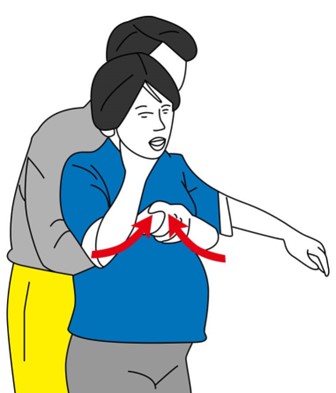
Move to the Heimlich maneuver in pregnancy only if the airway obstruction is severe, such as when she cannot speak, cannot breathe, cannot cough effectively, or shows signs of severe distress.
In pregnant women, if the uterus is above the umbilicus, use chest thrusts instead of abdominal thrusts. Place your hands on the middle of the chest and give quick inward thrusts. This modified approach helps avoid pressure on the enlarged uterus.
If the woman becomes unresponsive, lower her carefully to the ground, call EMS if not already done, and begin the chest compressions right away. If you see an object in the mouth before giving breaths, remove it carefully. Then continue CPR and use an AED as soon as it is available.
Conclusion: Learn the Basics, but Take a Certified Course
Knowing the basics of basic life support in pregnancy can help families and bystanders act quickly in a true emergency. The key steps are simple but powerful:
- Check for safety
- Assess responsiveness
- Call for help
- Activate EMS, get an AED
- Assess victim’s pulse and breathing
- Start CPR if needed
- Use an AED as soon as possible
- Manage choking correctly
- Continue until EMS arrives
Still, this article is only a general overview. It is not a replacement for an official BLS or CPR course. Taking a certified course can help people feel more prepared and more confident in a real emergency.
If you are pregnant, live with someone who is pregnant, or support pregnant family members, it is worth considering formal CPR and BLS training. For all pregnancy-related health concerns, always rely on the advice of qualified healthcare professionals.
Feel free to share your experience with emergencies in pregnancy and how prepared you felt when dealing with them. Do you feel more confident in facing emergencies after reading this article? How about after taking a basic life support course? We are looking forward to hearing your thoughts on this subject and what you think is the best subject to cover in our next post.